
Somaliland’s Growing Global Engagement: President Irro’s Washington Mission and a New Phase of International Diplomacy

From Washington policy circles to Capitol Hill, Somaliland is seeking to translate its strategic location, democratic institutions and growing international relationships into deeper political, economic and security partnerships.
Somaliland’s international engagement entered another important phase in September 2026 as President Abdirahman Mohamed Abdullahi “Irro” led a high-level delegation to Washington, D.C., on his first visit to the United States since winning the November 2024 presidential election. The delegation arrived on September 5 and included senior officials responsible for foreign affairs, defence, aviation and presidential policy. According to Somaliland’s Ministry of Foreign Affairs, the mission was centred on diplomatic relations, economic cooperation, security, investment and Somaliland’s international recognition campaign.
The visit came during a period of expanded international activity under President Irro’s administration. In 2026, Somaliland participated in the World Economic Forum in Davos for what the Somaliland Presidency described as its first engagement at the annual gathering; President Irro subsequently made a state visit to Israel following Israel’s December 2025 decision to formally recognize Somaliland. Israeli government and Knesset records confirm the establishment of diplomatic relations, the appointment of Somaliland’s first ambassador to Israel and President Irro’s June 2026 state visit.
A Major Washington Platform: The Hudson Institute
A central moment of the Washington visit came on 14 September 2026, when President Irro addressed the Hudson Institute at an event titled “Somaliland as a Strategic Partner in the Horn of Africa.” Hudson described it as his first U.S. visit since his presidential election and hosted a keynote address followed by an extended discussion with Senior Fellow Joshua Meservey, whose work focuses on African geopolitics, security and great-power competition.
The significance of the Hudson discussion was not simply that Somaliland’s president spoke in Washington. President Irro used the platform to frame Somaliland’s relationship with the United States around tangible areas of cooperation: Red Sea and Gulf of Aden security, Berbera, trade, investment, natural resources and regional stability. Somaliland’s Foreign Ministry said the president presented the country’s electoral history, peaceful political transitions and functioning institutions as part of his case for deeper U.S. engagement.
The president also argued that Somaliland’s geography gives it particular relevance to international maritime security. Berbera lies on the Gulf of Aden, close to shipping routes connecting the Indian Ocean, Bab el-Mandeb, the Red Sea and the Suez system. In his presentation, Irro also promoted the Berbera Economic Zone and wider commercial access toward Ethiopia and East Africa as opportunities for international investors.
This represented a notable diplomatic message: Somaliland was not presenting recognition only as a historical or legal question; the administration was also attempting to demonstrate what practical cooperation with Somaliland could offer international partners.

From Recognition to Economic Partnership
That approach was particularly visible in President Irro’s interview with Semafor Africa during the Washington visit. He discussed opportunities for U.S. investors involving Berbera, minerals and other resources, while describing deeper security access as something that would require negotiation rather than an automatic concession.
His formulation was direct:
“We are not giving anything for free.”
He said Somaliland expected partnerships to produce reciprocal opportunities and benefits, while stressing that economic cooperation, investment and trade could develop alongside the recognition issue.
This commercial emphasis is consistent with other initiatives pursued during his administration. The Somaliland Presidency has reported engagement with international investors in minerals and infrastructure, while President Irro’s April 2026 State of the Nation address identified agriculture, livestock, fisheries, natural resources, exports, infrastructure, health, education, water and energy among the government’s development priorities.
Capitol Hill and the Washington Policy Community
President Irro’s engagement extended beyond the Hudson Institute. Somaliland’s Foreign Ministry reported meetings with members of the United States Congress focused on security, trade, strategic cooperation, investment and stability in the Horn of Africa and Red Sea region. Separate reporting identified discussions with lawmakers including Senator Mike Rounds and House Foreign Affairs Committee Chairman Brian Mast.

On 19 September, President Irro also met Senator Ted Cruz on Capitol Hill. According to Somaliland’s Foreign Ministry, their discussions covered recognition, U.S.–Somaliland strategic cooperation, security, economic relations and regional stability.

The president additionally met specialists from the Atlantic Council and the Foundation for Defense of Democracies on September 17, where discussions addressed the Horn of Africa, Gulf of Aden, maritime routes, Berbera and the potential for expanded strategic cooperation with the United States.
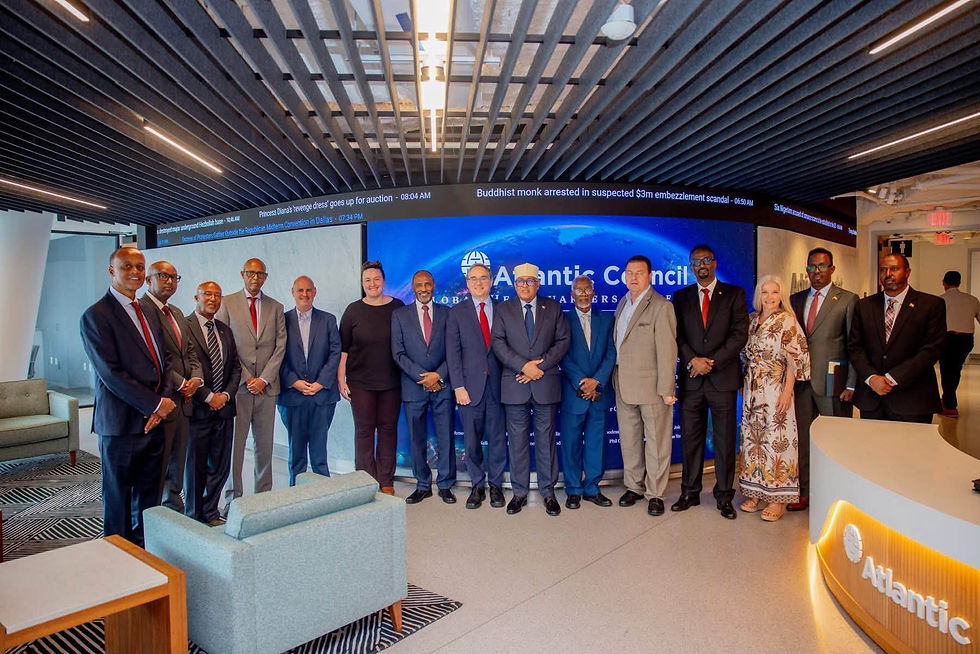
These engagements matter because Washington policy formation does not occur in a single institution. Congress, think tanks, business networks, security specialists, diaspora communities and the executive branch all form parts of the wider policy ecosystem. At the same time, meetings with think tanks or lawmakers should be distinguished from a formal change in U.S. recognition policy.
Building on a Broader Diplomatic Record
The Washington mission also forms part of a wider diplomatic strategy pursued since President Irro entered office in December 2024.
One of the most consequential developments occurred on 26 December 2025, when Israel formally recognized Somaliland as an independent and sovereign state and the two sides announced full diplomatic relations. Israel’s government says the agreement included the appointment of ambassadors and establishment of embassies. Somalia’s federal government rejected that decision and maintains that Somaliland remains part of Somalia, illustrating the continuing international dispute surrounding Somaliland’s status.
The relationship subsequently produced Somaliland’s first ambassadorial accreditation in Israel in May 2026 and President Irro’s official state visit the following month. During that visit, Israeli and Somaliland officials discussed security, investment, technology, agriculture and other forms of cooperation.
Domestically, the Somaliland Presidency has also highlighted security-sector reforms, preparation of a National Security Strategy and continuing reconciliation initiatives. Its 2026 State of the Nation address said the government had pursued peace efforts in several regions while continuing dialogue on unresolved eastern disputes. Because these assessments come from the government itself, they are best understood as the administration’s account of its record and priorities.
Infrastructure and energy have also featured in the administration’s public agenda. In February 2026, President Irro inaugurated roads, municipal facilities and civic projects in Berbera, as well as a 5 MWp solar-power expansion project and an 11.2-kilometre transmission line. The Presidency states that the projects were intended to improve electricity capacity, connectivity and public services in the port city.
The Diaspora Remains Central
President Irro concluded an important part of the Washington programme by meeting members of the Somaliland diaspora in North America. He highlighted the diaspora’s contributions to investment, national development, community welfare and international engagement.

For institutions such as the Somaliland Diaspora Council (SLDC), this dimension is especially important. Somaliland’s diaspora is not simply a source of remittances; it can also connect professionals, investors, policymakers, researchers and institutions across Europe, North America, the Middle East and Africa.
SLDC therefore welcomes sustained efforts that expand Somaliland’s constructive international engagement, strengthen economic opportunity, promote institutional development and create channels through which the diaspora can contribute its expertise and networks.
The Council also welcomes the emphasis placed during the Washington visit on building partnerships based on mutual interests, investment, security cooperation and long-term institutional relationships.
SLDC: Connecting the Diaspora to Somaliland’s Future
The Somaliland Diaspora Council — Connect • Empower • Build believes that international diplomacy and diaspora engagement should reinforce one another.
As Somaliland expands its conversations with governments, legislators, policy institutions and investors, the diaspora has an important complementary role: building professional relationships, communicating Somaliland’s development priorities, facilitating investment connections and strengthening cooperation between Somaliland and the countries in which diaspora communities live.
President Irro’s Washington mission illustrates how Somaliland is seeking to move these conversations into major international policy centres. The ultimate outcomes will depend on concrete follow-through — new partnerships, investment, institutional agreements and future diplomatic decisions — rather than meetings alone.
For SLDC, the priority remains clear: to connect Somaliland’s diaspora talent and networks with opportunities that contribute to Somaliland’s peaceful development, economic growth and constructive international engagement.


Comments